
A guide to every option on a quota and on a quota group, in plain language, so you know what you are turning on before you field the survey.
What a quota is#
A quota is a cap on how many people matching a condition may complete your survey. For example: "stop after 200 women aged 25–34."
Every quota has three parts:
- A quota type — whether it counts everyone, or only a segment (see below).
- A response limit — how many completes to allow.
- A "when full" action — what happens to the next matching person once the limit is reached.
A segment quota adds a fourth part: a condition, saying who the quota is about. It uses the same builder you use for display and skip logic.
Three things worth knowing up front:
- A quota always counts, whatever its action. A quota set to Nothing (tracking only) still keeps a running total — it just never turns anyone away. That is how you build a counter that other quotas can share.
- Only completed responses count. Partials, screen-outs, quality-control failures and abandoned sessions never increment a quota on their own. Previewing your survey doesn't affect live counts either.
- Except when you promote one by hand. Marking a partial or a terminated response complete on the Analytics page counts it toward your quotas from that moment, exactly as if the respondent had finished. That includes screen-outs, quality-control removals and quota returns that turned someone away part-way through — none of those was ever counted, so promoting one adds to the counter. The only response that doesn't move a counter is one that had already answered its way to the end before a full quota handed it back: that quota counted it at the time, so promoting it can't count it twice. Because a promotion is a deliberate override, it can take a quota past its own limit — a quota capped at 50 can read 51/50 after one. If you would rather it didn't, tick Keep quotas within their limits in the confirmation and Intuify refuses any promotion that would go over instead. See Marking a response complete.
Quota settings#
Quota Type#
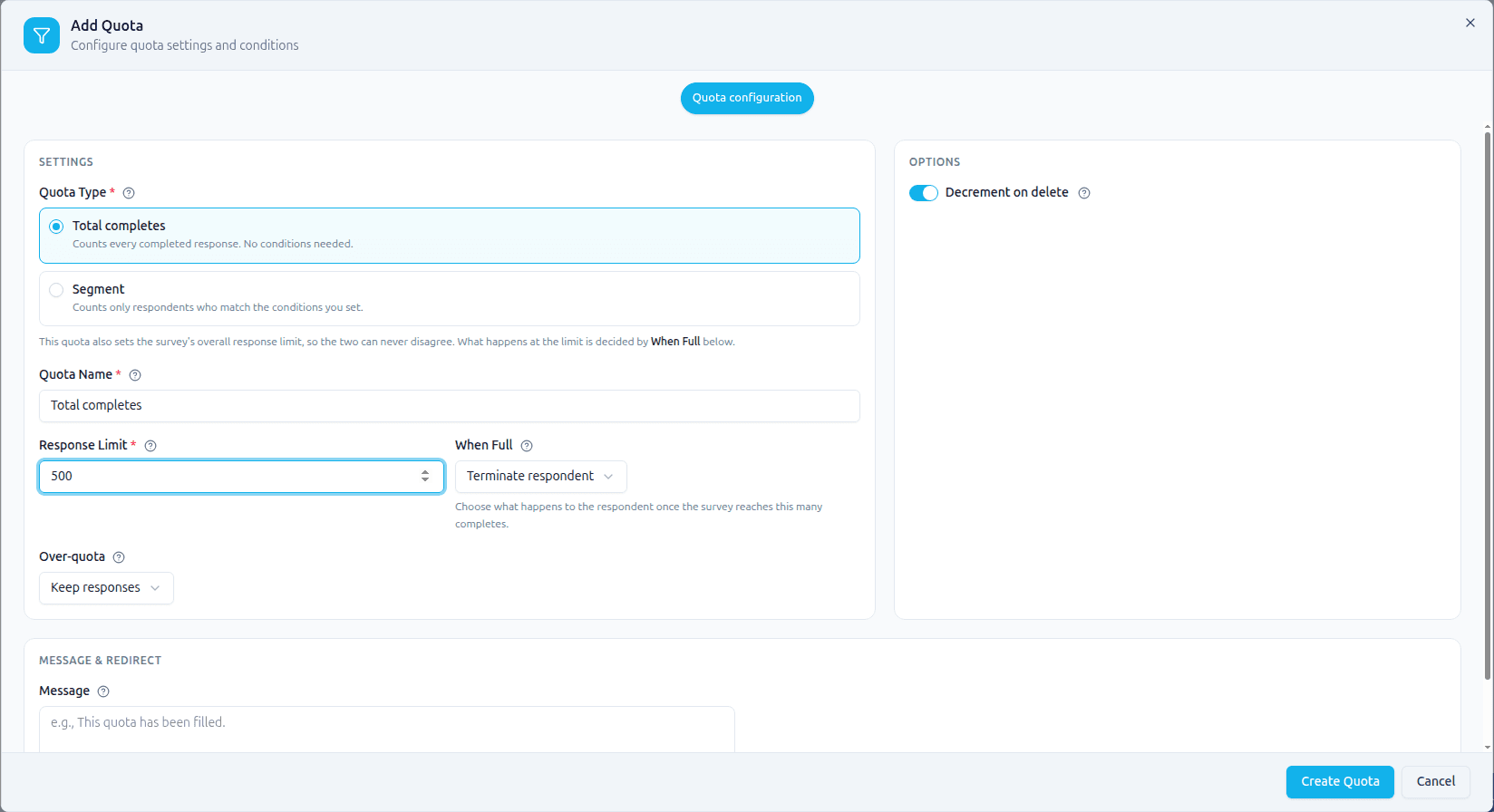
The first choice on a new quota, because it decides whether there is a conditions step at all.
| Option | What it counts |
|---|---|
| Total completes | Every completed response. No condition, nothing to configure beyond the limit and the action. |
| Segment | Only the respondents matching the conditions you write on the next step. This is what every older quota is. |
Total completes is how you cap a study overall — "stop this survey at 500 completes" — so fielding closes on its own instead of relying on someone watching the counter. Everything else about it is an ordinary quota: it has a live count, a when-full action, group assignment, the active toggle, and it shows up wherever other quotas do.
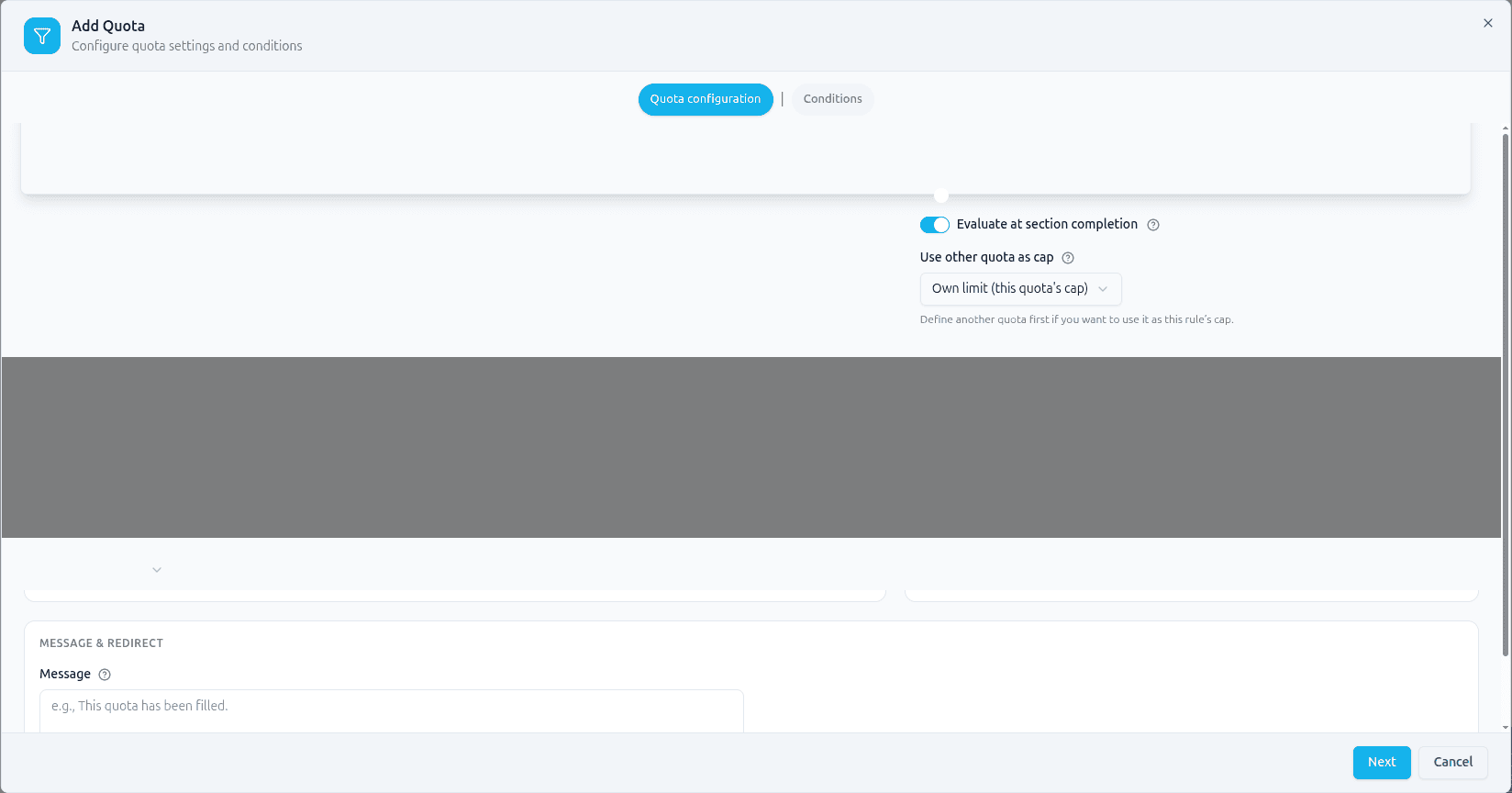
Choosing Total completes removes the Conditions step from the dialog — there is nothing to write — so the quota is finished on the first step and the button reads Create Quota instead of Next. Two options also disappear, because they have nothing to act on: Evaluate at section completion (a total quota is matched at the first check whatever it says) and Use other quota as cap (there is no borrowed cap). Over-quota handling and Decrement on delete still apply and stay.
In the quota list a total quota is badged TOTAL COMPLETES, so you can tell at a glance which rule caps the whole study and which caps a segment. Everything else on the card — the counter, the progress bar, the when-full badge, and the counter tools — works exactly as it does for any other quota.
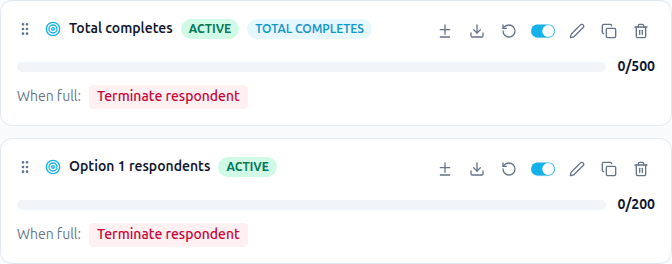
There is no need to fake a total quota with an always-true condition. If you have an older quota built that way, edit it and switch it to Total completes — the meaningless condition is removed when you save.
Total completes and the survey's overall response limit#
A survey record also carries an overall response limit (maxResponses), which
the public API and Qualtrics imports can set. A total-completes quota owns
that number. Saving one writes the survey's limit to match, and deleting or
deactivating it clears the limit again, so the two can never disagree.
Enforcement is the quota's, not the setting's. The bare setting can only refuse to start a new session; a quota can terminate, redirect, close the survey, block new sessions, or just track. So while a total quota is active, what happens at the cap is whatever its When Full says.
Quota Name#
Your own label for the quota. It appears on the quota card, in the public dashboard, and in reports. Respondents never see it, so name it for yourself — "Female 25-34 metro" is more useful than "Quota 3".
Response Limit#
How many completes to allow — matching completes for a segment quota, all of them for a total quota. Minimum 1.
Response Limit lives on the Configuration step of the quota dialog. When you are editing an existing quota, Update Quota is on that step too, so changing only the limit takes one click and you never have to walk through Conditions to commit it. (Next is still there if you do want to review the conditions; it is the quieter of the two buttons because Update is the one that saves.) A brand new segment quota still has to pass through Conditions before it can be created, because it has nothing to match on until you write them.
When Full#
What happens to the next matching respondent once the limit is reached. The help icon next to When Full in the quota dialog lists the same five options.
| Option | What it does |
|---|---|
| Terminate respondent | The respondent is ended and marked as a quota-full termination. A respondent who came from a panel is sent to that panel's Quota Full link; anyone else sees the quota message. |
| Redirect respondent | Same as terminate, but they're sent to a URL you choose. |
| Close survey | Ends this respondent and closes the whole survey to everybody. Use with care — this is not limited to people matching the quota. |
| Block new sessions | Stops new people from starting. Anyone already partway through is allowed to finish and submit. Useful when you don't want to discard work in progress. |
| Nothing (tracking only) | Counts, but never turns anyone away. Use this for a pure counter, or to watch a segment fill before you decide to cap it. |
Over-quota#
What to do with a response that arrives when the quota is already full.
| Option | What it does |
|---|---|
| Keep responses (default) | The response is kept. |
| Delete responses | The response is removed from your results. |
Two things to understand about Delete responses:
- It's recoverable. Deleted responses are hidden and excluded from results and exports, not destroyed. This is deliberate — the deletion happens automatically, with nobody reviewing each one, so a mistyped limit or a wrong condition must be undoable.
- It does not change the quota count. A response that arrived over the limit was never counted toward the quota in the first place, so removing it doesn't free up a slot. If it did, the quota would reopen, let another person in, go over again, and drift further off target with each cycle.
If your survey is fed by a panel, note that a completion already reported back to the panel still stands. Your counts and the panel's can legitimately differ on a survey that deletes over-quota responses.
Group#
Which quota group this quota belongs to. See Quota Groups below. Leave it unset if the quota stands alone.
Decrement on delete#
On by default. When you delete a response that this quota counted, the count goes down by one, so the quota can accept a new complete in its place. Turn it off if you want the quota to stay closed once it has been filled, regardless of later clean-up.
This applies to responses you delete. It does not apply to responses removed automatically for arriving over the limit — those were never counted, as explained above.
Evaluate at section completion#
On by default, and only relevant for quotas that turn respondents away.
When on, the quota is checked when a respondent finishes a section, rather than after every single page. This stops someone being cut off halfway through a section. Turn it off if you need the quota enforced at the earliest possible moment.
Use other quota as cap#
Lets this quota use another quota's count and limit as its cap, instead of its own Response Limit.
The usual pattern: create one Nothing (tracking only) quota that counts a segment, then point several terminate quotas at it. They all share one cap, and you change that cap in one place.
If the quota it points at is ever removed, this quota falls back to its own Response Limit rather than becoming uncapped.
Message#
What a respondent sees when they're turned away because this quota is full. Supports your survey's translations.
Redirect destination#
Only shown when When Full is set to Redirect respondent.
| Option | What it does |
|---|---|
| Redirect to panel link | Sends the respondent back to the panel they came from, using the panel's own quota-full URL. |
| Redirect to fixed link | Sends them to a URL you type in. |
For panel traffic, the panel's own return URL always wins, even if you've set a fixed link. The fixed link applies to respondents who did not arrive from a panel.
A redirect URL you've entered stays saved and stays in effect if you later switch When Full to Terminate or Close survey. When that happens the URL is shown separately so you can see it and clear it — otherwise it would keep redirecting people invisibly.
Conditions#
Who this quota counts. Built with the same condition builder as display and skip logic, so it supports nested groups and any/all logic.
A quota with no conditions counts nobody — the conditions are what identify the segment.
Don't add a condition for whether someone completed. Only completed responses count toward a quota. Partials, screen-outs, quality-control failures and abandoned sessions never add to it, so a condition that checks whether someone finished is neither needed nor useful here. Adding one delays the quota until the last page, which terminates respondents at the very end of the survey instead of stopping them early. The quota dialog says the same thing above the condition builder.
Watching and correcting the count#
Each quota card shows a live count and a progress bar, refreshed about every ten seconds while you have the Quotas tab open. Next to it sit three counter tools. They act on real respondent data, so they are hidden while you are editing a template.
| Tool | What it does |
|---|---|
| Adjust current count | Set the count to a number you type. Opens the Edit Count dialog. |
| Export respondent IDs | Downloads a CSV of the respondents this quota has counted. |
| Reset count to 0 | Starts the quota over from now. |
Adjusting the count#
Use this when the number the system worked out is not the number you want to field against: responses collected before the quota existed, a partner supplying completes outside this survey, or a segment you have already filled elsewhere.
Your number sticks. It is stored permanently, so it survives a publish, a server restart, and any amount of time passing. It is also the starting point, not a ceiling: completes that arrive afterwards are added on top of it. Set a quota to 120 and the next matching complete puts it at 121.
That "added on top" is deliberate, and it is the part worth understanding before you use the tool on a live study:
- It means an adjustment can never hide over-collection. If the survey really is collecting matching completes, the number keeps climbing and you will see it.
- It also means adjusting the count is not a way to raise a cap. If you need more completes, raise the Response Limit. Typing a lower count buys you room only until the difference fills back in.
Adjust and Reset both take effect from the moment you use them, and the more recent one wins. Reset after an adjustment throws the adjustment away and starts from zero. Adjust after a reset replaces the reset with your number. Neither is affected by publishing.
If the count cannot be saved, you get an error telling you why and the dialog stays open with your number in it. A success message now means the count really was stored.
Two side effects worth knowing, because setting a count also moves the quota's starting line to that moment. Both apply to a reset in exactly the same way:
- Export respondent IDs lists only the respondents counted since the adjustment, so the file will have fewer rows than the number on the card. The difference is the number you typed, which stands in for the history before it.
- Decrement on delete only applies to responses completed since the adjustment. Deleting an older response does not lower the count, because your number already accounts for it.
Resetting the count#
Reset sets the quota to zero and, from that moment on, counts only responses completed after the reset. It does not delete or alter any response, and it does not change what the quota matches. Use it when you are restarting fielding on a segment and want the earlier completes left out of the cap.
Like an adjustment, a reset is stored permanently and survives publishing. And because the later of the two always wins, resetting clears a number you set earlier with Adjust current count — the quota starts again from zero, not from your number. That is intended: the reset already leaves out the history your number stood for, so keeping it would count that history twice. If you want the quota to start from a particular figure, use Adjust current count on its own. There is no need to reset first.
Quota Groups#
A group answers one question: when someone matches several of your quotas at once, which one should they count toward?
It's also the unit you share publicly — a group has one dashboard showing all the quotas inside it.
Group name#
Identifies the group in the builder and on its public dashboard. You can rename a group at any time by clicking its name.
Public dashboard#
Publishes a live, read-only page showing the fill status of every quota in the group. Useful for sharing progress with a client without giving them builder access.
The whole group is shared, including every quota inside it — there is no per-quota privacy setting.
Assignment rule (multiple match)#
What happens when a respondent qualifies for more than one quota in this group.
| Option | What it does |
|---|---|
| Place in all matching | Count them toward every quota they match. |
| Defined order (first) | Count them toward the first matching quota, using the order the quotas appear in the group. Drag to reorder. |
| Reverse order (last) | Count them toward the last matching quota. |
| Least filled | Count them toward whichever matching quota has the lowest count. |
| Least filled % | Count them toward whichever matching quota is the least full relative to its own limit. |
| Most filled | Count them toward whichever matching quota has the highest count. |
| Most filled % | Count them toward whichever matching quota is the fullest relative to its own limit. |
A worked example#
Say a Regions group holds two quotas:
- North — limit 100, currently at 80
- Urban — limit 50, currently at 20
Someone who is both North and Urban matches both quotas. Here's where each setting sends them:
| Setting | Who gets the respondent | Why |
|---|---|---|
| Place in all matching | Both — North → 81, Urban → 21 | They count more than once, so your quota totals can add up to more than the number of people who took the survey |
| Defined order (first) | North | It's first in the group's list |
| Reverse order (last) | Urban | It's last in the list |
| Least filled | Urban | Fewest responses so far: 20 against North's 80 |
| Least filled % | Urban | Furthest from its own target: 40% full against North's 80% |
| Most filled | North | Most responses: 80 |
| Most filled % | North | Closest to its target: 80% full |
The plain and percentage versions only disagree when your quotas have different limits. Give both a limit of 100 and Least filled and Least filled % always pick the same quota.
Which one to choose#
- Place in all matching — you're tracking overlapping segments and want each counted honestly in its own right.
- Defined order / Reverse order — you want a priority you control, one that doesn't shift as counts move.
- Least filled / Least filled % — you want quotas to fill evenly and finish around the same time. Use the % version when limits differ.
- Most filled / Most filled % — you'd rather close nearly-complete quotas first than spread effort across all of them.
Things that catch people out#
Duplicating a quota starts it at zero. A copy counts only responses that arrive after you made it, not the original's history. That's almost always what you want — but if you were expecting the copy to show the same number as the original, this is why it doesn't.
Deactivating a quota freezes its count. Switching a quota off stops it counting from that moment. Switching it back on resumes counting; it does not retroactively pick up what happened while it was off.
"Close survey" closes everything. It's easy to read it as "close this quota". It ends the survey for all respondents, not just those matching the quota.
A tracking-only quota still counts. If a number is climbing and you can't see why anyone is being turned away — that's the expected behaviour of Nothing (tracking only).
Respondents being terminated on the very last page usually means a completion condition. If a quota is turning people away at the end of the survey rather than early, check its conditions for anything that only becomes true once someone finishes — typically a global variable set on the last page. A quota cannot match anyone until all of its conditions are true, so a completion check holds the whole quota back to the final page. You don't need one: quotas already count only completed responses. Remove it and the quota goes back to stopping people as soon as they match. A second thing to check is Evaluate at section completion, which is on by default and only tests the quota at the end of each section.
Changing a quota's conditions changes what it counts. Because counts are worked out from your actual responses, editing a live quota's conditions can move its number up or down at the next publish. Check the count after editing a quota on a survey that's already collecting.
Publishing recalculates counts, but it does not undo an adjustment or a reset. Every publish rebuilds each quota's count from your responses, which is how the count picks up things a running total cannot see. A count you set by hand, and the moment you set it, are kept through that rebuild: the survey recounts from your number, forward. The same is true of a reset. If a number you typed used to come back changed after publishing, that was a bug and it is fixed.
A quota's count is not part of the survey you save. It belongs to the responses, not to the design. Adjusting or resetting a count is not an edit, so it does not mark the survey unsaved, does not need publishing, and is not captured in Version History.
Related guides#
- Logic, Flow & Conditions — building the conditions a quota matches on.
- Fielding & Respondent Experience — what a terminated respondent sees.
- Analytics & Responses — where quota counts and terminations show up in your data.
Was this page helpful?