
Mode: configuration.maxDiffDesign = "tournament"
Demo survey: SV_cI6Qsy6aoNpONZSj ("MaxDiff Tournament demo - 8 items, 4 per screen (docs)", dev) · respondent link /s/SV_cI6Qsy6aoNpONZSj
What it is#
A single‑elimination bracket (PPT slide 7). Items are split into groups; on each screen the respondent's Best pick wins its group and advances. Winners form the next round, and this repeats until one overall winner remains. It is adaptive — the next round depends on the respondent's actual picks — and the screen count is determined by the bracket, not a fixed number. Mutually exclusive with the Bandit.
Configuration used#
| Setting | Value |
|---|---|
| Design of Experiment | Tournament |
| Items per screen (group size) | 4 |
| Items | 8 |
| Screen count | dynamic (bracket‑determined) |
How it builds rounds#
Round 1 = a seeded shuffle partitioned into groups of 4. Each screen's Best advances (an odd leftover item gets a bye). The next round only appears once the current round is fully answered. Editing an earlier Best rewrites the affected downstream screens.
Every screen shows the full number of items#
Every Tournament screen shows exactly Items per screen items, the final included. When a round has fewer contenders left for a screen than that (for example the final, which holds the two round‑1 winners), the screen is filled with other items:
- items whose score so far is 0 or more come first (score = times picked Best − times picked Worst by this respondent on the screens before this one; items already knocked out count too), so an item the respondent has just picked Worst is not brought back;
- among those, the items the respondent has seen least come first, ties at random;
- only if there are not enough such items are items with a negative score used, so the screen is still full (a safety net: each answered screen leaves all but one of its items at 0 or more, so this does not arise in practice);
- a fill-in never shares the screen with an item it is constrained against while another item can take its place.
Fill-ins compete like any other item: if one is picked Best, it advances. The filled screen is shuffled, so fill-ins are not always listed last. A single leftover item still sits out a round (a bye), because it does not make a screen. For example, with 5 items and 4 per screen the respondent sees two screens of 4: round 1, then the round‑1 winner and the item that sat out, plus two fill-ins.
The round‑1 shuffle seed combines the question with the respondent's session id, so each respondent starts from a different bracket rather than everyone getting the same pairings. The seed is fixed for the duration of a session, so answering and back‑navigating never reshuffles a bracket mid‑flow.
Constraints in Tournament#
Tournament honours item‑pair constraints (QPM‑12897). Every round is built so that no constrained pair shares a screen — round 1, each later round built from the winners, and the final. If a round cannot be built without seating a constrained pair together (for example the final's two contenders are a constrained pair), that constraint is ignored for that round only; every other round still honours it. The Constraints card is shown for Tournament as for the other designs. The builder's "too tight" warning is not shown for Tournament, because Tournament never ships a short screen: it relaxes the constraint for that round instead. A Tournament with no constraints builds exactly the same bracket as before.
Live run — winners advance, every screen full (8 → 2 → 1)#
Recorded on the dev server on 21 Oct 2026, answering as a respondent. The respondent picked the first‑listed item as Best and the last‑listed as Worst on each screen. Items are shuffled per respondent, so another respondent gets different groups.
Round 1 — two groups of 4#
| Screen | Items shown | Best → advances | Worst |
|---|---|---|---|
| 1 (1/2) | Eco‑friendly · Delivery speed · Quality · Design | Eco‑friendly | Design |
| 2 (2/2) | Brand reputation · Warranty · Price · Customer support | Brand reputation | Customer support |
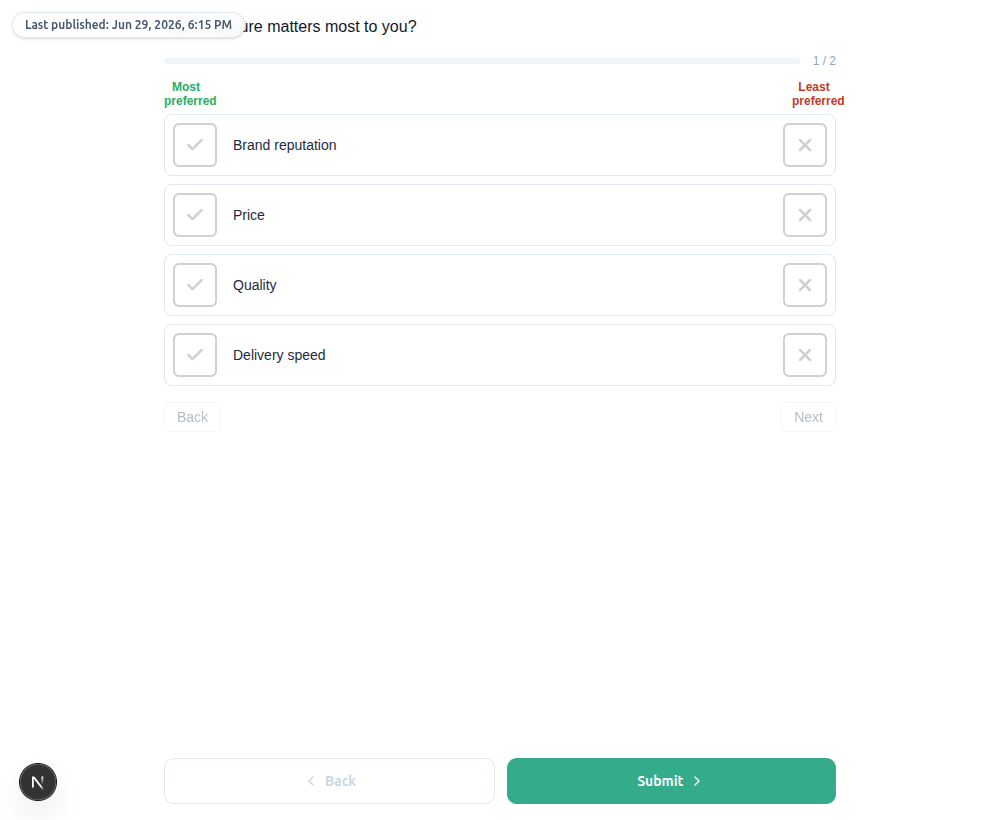
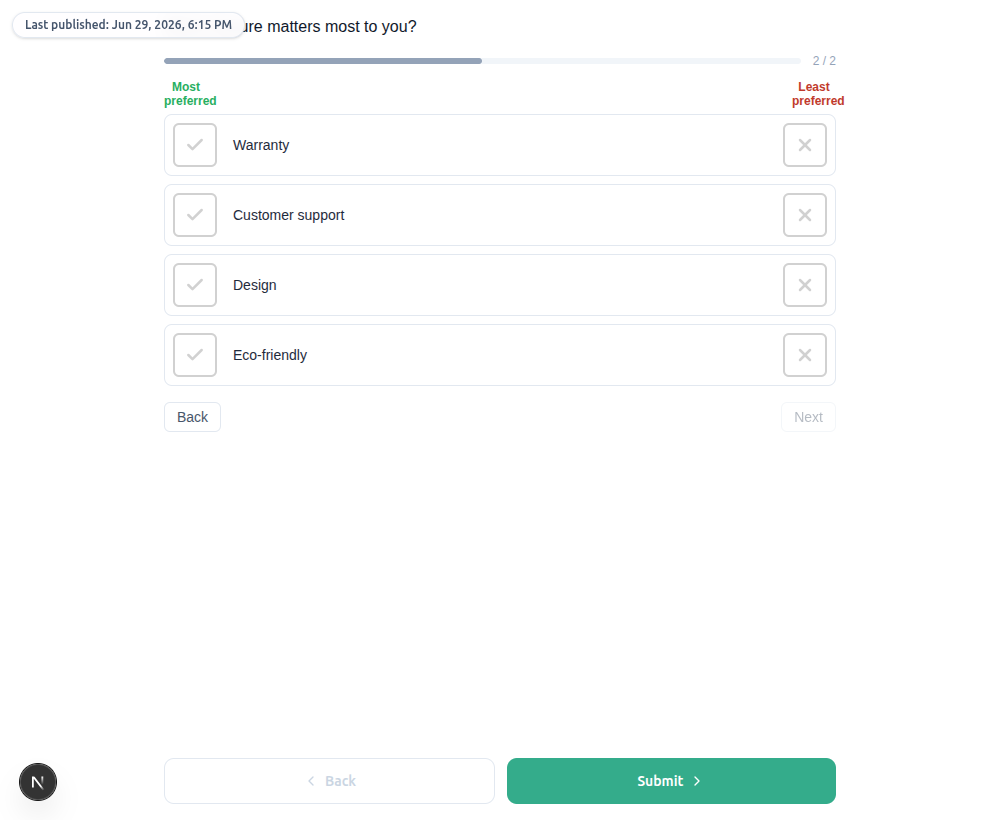
Round 2 — the final, filled to 4 items#
| Screen | Items shown | Best → WINNER |
|---|---|---|
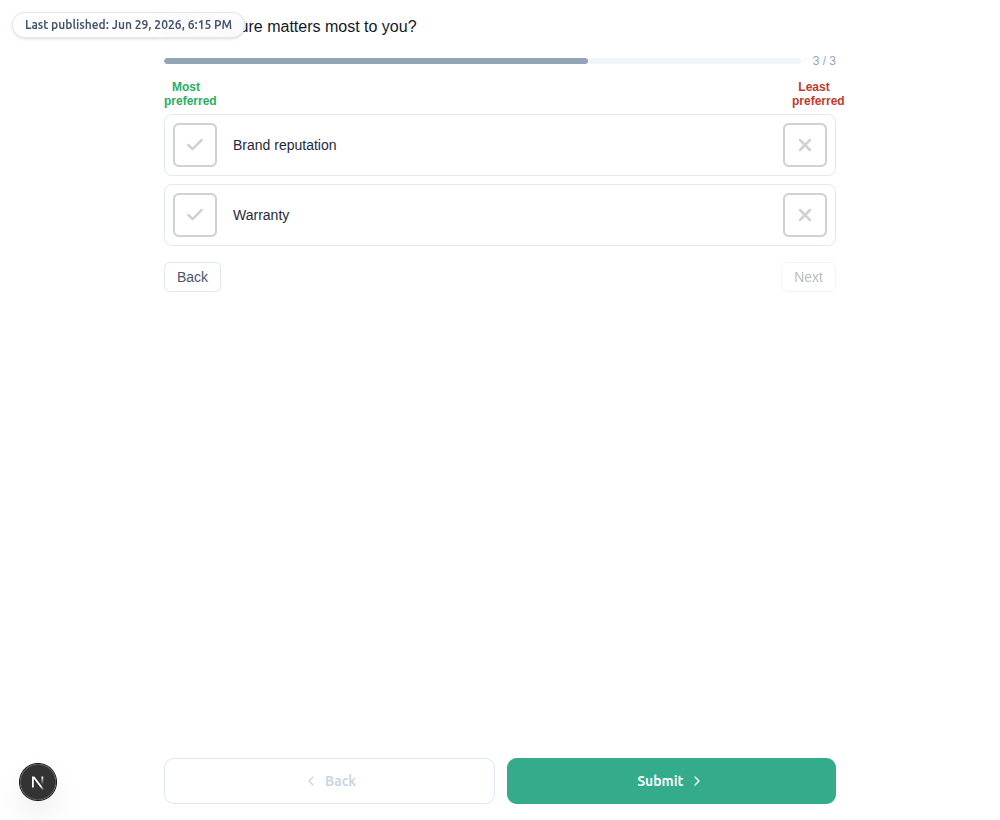
| 3 (3/3) | Eco‑friendly · Quality · Warranty · Brand reputation | Eco‑friendly |
The two round‑1 winners (Eco‑friendly, Brand reputation) meet in the final. The other two places are filled with Quality and Warranty: items with a score of 0 (shown once, never picked Best or Worst). Design and Customer support were picked Worst in round 1, so they are not used to fill.
Result#
8 items
  ├─ Round 1 screen 1: {Eco, Delivery, Quality, Design}        → Eco advances
  ├─ Round 1 screen 2: {Brand, Warranty, Price, Support}       → Brand advances
  └─ Round 2 (final):  {Eco, Brand} + fill-ins {Quality, Warranty} → ECO-FRIENDLY wins
- The progress indicator grew 1/2 → 2/2 → 3/3 as round 2 was revealed after round 1 finished.
- Every screen showed 4 items, the final included.
- Total screens shown: 3 (2 in round 1 + 1 final), narrowing 8 candidates to 1 winner.
Was this page helpful?